Why it matters. Nvidia is the world's most valuable chipmaker, and its push into PCs could reshape the laptop and desktop market long dominated by Intel and AMD — affecting prices and product choices for consumers worldwide.
Background. South Korea is the center of global memory-chip manufacturing through Samsung Electronics and SK hynix, so any new AI device that needs lots of memory directly benefits its economy. The country's economy is led by a handful of family-run conglomerates known as 'chaebol' — SK, LG, Samsung, Hyundai — whose chairmen wield enormous influence, which is why Jensen Huang dining with them is treated as major business news. 'Samgyeopsal' (grilled pork belly) dinners are a quintessentially Korean setting for informal, relationship-building conversation.
What to watch next. Watch whether Huang's Korea visit produces concrete memory-supply deals with Samsung or SK hynix and how Intel and AMD respond to Nvidia's PC-chip challenge.
Nvidia moves into personal computers
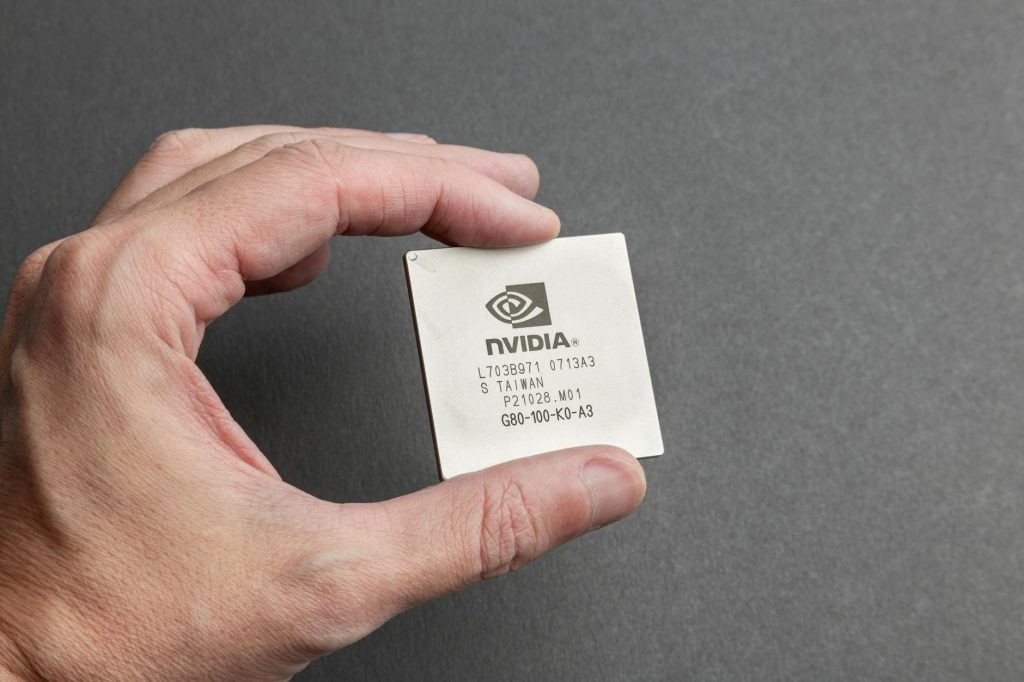
Nvidia, the U.S. company that dominates the global market for artificial-intelligence chips, announced on June 1 at the Computex trade show in Taipei, Taiwan, that it is entering the personal-computer market with a new processor called the RTX Spark superchip — a direct challenge to Intel and AMD, the two firms that have long ruled the laptop and desktop business. CEO Jensen Huang unveiled the palm-sized chip on stage, drawing a burst of camera flashes.
Until now, Nvidia has been known mainly for gaming graphics cards and the large chips that power AI data centers. By moving into smaller consumer machines, the company is signaling a strategy to extend its grip across the entire AI-chip market — from big tech firms down to individual buyers.
What the RTX Spark actually is
The RTX Spark bundles three components into a single package: Nvidia’s own central processing unit (CPU), called Grace; its graphics processing unit (GPU), called Blackwell; and 128 gigabytes of memory. Major PC makers including Dell and Lenovo are expected to ship laptops and desktops built around it in the second half of this year.
Crucially, the chip’s CPU is based on a design from Arm, the British chip-architecture firm, and was developed with Taiwan’s MediaTek; Taiwan’s TSMC will manufacture the package. This pits Arm-based processors against the x86 architecture that Intel and AMD have used for decades. The two approaches involve a trade-off: x86 chips tend to deliver higher raw performance, while Arm-based chips run cooler and use less power — a key advantage in thin, battery-powered laptops.
Why Korean companies are watching closely
The launch carries weight in South Korea, home to the world’s two largest memory-chip makers, Samsung Electronics and SK hynix. Because the RTX Spark relies on large amounts of high-performance, low-power memory, both firms could see demand grow. Notably, Chey Tae-won, chairman of SK Group (SK hynix’s parent conglomerate), attended Huang’s keynote in person.
Huang is due to fly to South Korea on June 4 after wrapping up his Taiwan schedule. Korean media expect him to hold an informal dinner — dubbed a “samgyeopsal meeting” after the grilled pork belly that is a staple of casual Korean get-togethers — with top business leaders, possibly including Chey, LG Group chairman Koo Kwang-mo and Naver founder Lee Hae-jin. It would echo a similar gathering last year with Samsung’s Lee Jae-yong and Hyundai Motor’s Chung Euisun.
During the visit, Huang is also reported to be planning to throw the ceremonial first pitch at a Doosan Bears baseball game at Jamsil Stadium in Seoul, and to host a roundtable with Korean executives at the Shilla Hotel.