Why it matters. Korea is quietly becoming a top-tier AI player not by building the biggest models, but by wiring AI into the factories and robots that make physical goods—a niche that matters as manufacturing economies race to automate.
Background. POSCO, whose research arm produced this report, is a global steel giant, signaling how heavily Korea's industrial conglomerates (chaebol) drive its AI push. The named model-makers span Korea's tech landscape: Naver is the dominant local search portal (Korea's Google), SK Telecom is a top mobile carrier, NCSoft is a major game studio, and Upstage is a homegrown AI startup. Korea has long led the world in factory robot density, a legacy of its export-driven manufacturing economy.
What to watch next. Watch whether Korea's cost-efficient, Korean-language-focused models can close the performance gap with US and Chinese frontier labs, or stay locked into a mid-tier niche.
South Korea ranked third in the world for launching “notable” artificial intelligence models and 18th for AI adoption, according to a June 1 report by the Posco Research Institute (POSRI) that analyzed Stanford University’s 2026 AI Index. The findings point to a fast-rising AI economy with a distinctive edge in factory and robotics applications.
The Stanford AI Index, published annually since 2017 by the university’s Institute for Human-Centered AI (HAI), is a widely cited, independent assessment of global AI research, performance, and deployment. POSRI is the in-house think tank of POSCO, one of Korea’s largest steelmakers.
A Surge in Adoption and “Physical AI”
Korea’s AI adoption rate climbed to 18th worldwide in the second half of last year, up seven places from 25th a year earlier. Its rate of increase—4.8 percentage points—was the fastest of any country. The report says Korean industry has entered a “transition momentum” phase, with companies and the public sector rolling out AI simultaneously.
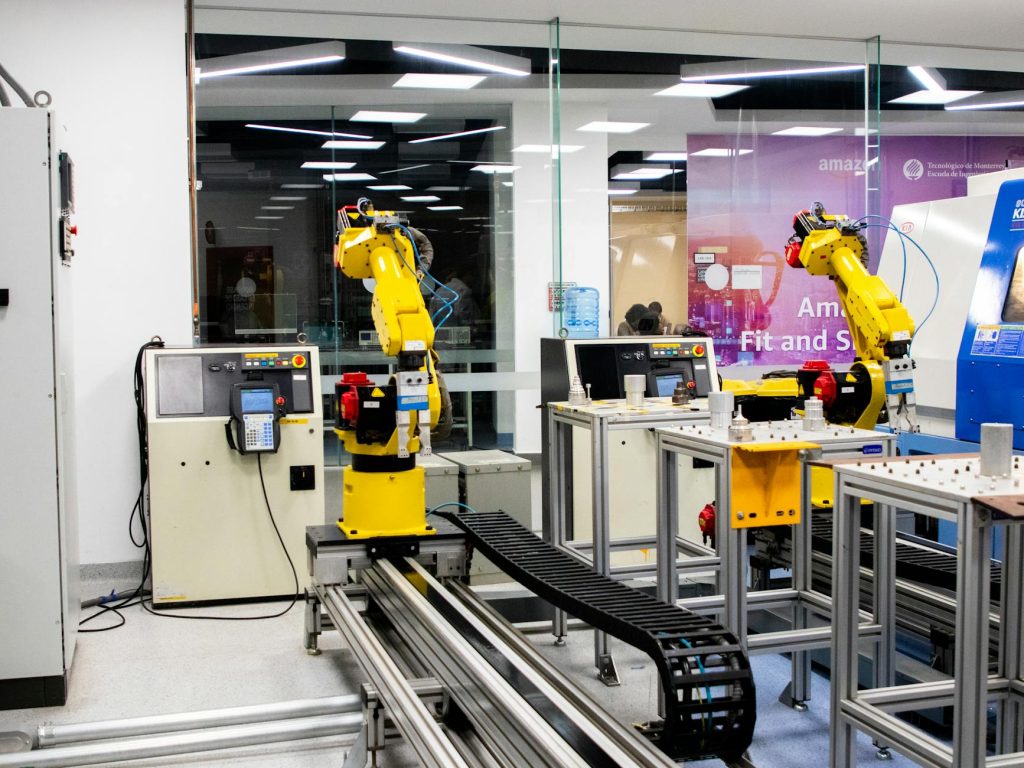
The standout strength is what the report calls “physical AI”—embedding AI into factories and robots. Korea installed 30,600 industrial robots, fourth globally behind China (295,000), Japan (44,500) and the United States (34,200). By robot density—robots per 10,000 workers—Korea remained number one at 1,012.
Strong Models, but a Performance Gap Remains
On model development, Korea released five “notable” large language models (LLMs) last year, ranking third after the United States (50) and China (30). The five came from LG AI Research, Naver, SK Telecom, Upstage and NCSoft—a mix of conglomerate labs, the country’s dominant search portal, a telecom carrier, an AI startup and a major game maker.
Rather than chasing scale, these models cluster around a mid-size class of roughly 30 billion parameters. The report frames this as a deliberate strategy emphasizing cost efficiency and Korean-language specialization, in contrast to the hundreds-of-billions or trillion-parameter frontier models from the US and China.
Korea also led the world for the second straight year in AI patent filings relative to population, at 14.31 per 100,000 people, ahead of Luxembourg (12.25), China (6.95) and the US (4.68). The report cautioned, however, that patent volume does not guarantee commercial success or model quality, and that Korea’s homegrown models still trail the world’s best by a wide margin in absolute performance. Korea’s AI market was estimated at about $9.06 billion, or 1.6% of the $581.7 billion global market.
The Global Picture
The report also tracked AI’s broader acceleration. On the SWE-bench coding benchmark—a standard test of AI coding agents—completion rates jumped from 60% to roughly 100% (the human baseline) in a single year. AI adoption among global firms reached 88%, and generative AI reached 53% of the world’s population within three years of launch, spreading faster than the PC (about 10 years) or the internet (about 7 years).
At the same time, the report flagged a concentration of AI development in a handful of big tech firms and shrinking disclosure. More than 90% of notable frontier models last year came from industry; only 7 of 87 came from academia or government. As leading labs such as Google, Anthropic and OpenAI stopped publishing training-data and training-time details, a transparency index fell from 58 to 40—a sign, the report argues, that capability is outpacing accountability.