Why it matters. Advanced economies everywhere face the same problem: irreplaceable hands-on expertise walking out the door as skilled workers retire, and South Korea's state-led attempt to digitize it is an early test case the rest of the industrial world will watch.
Background. South Korea built its wealth on heavy manufacturing — steel, ships, cars and chips — and the sector matters far more to its economy than in most rich countries. POSCO is the national steel champion, founded with state backing in 1968 and long treated as a symbol of the country's industrialization. The "master craftsman" (myeongjang) title is a formally recognized honor in Korea, and the cohort now retiring built much of that postwar industrial base.
What to watch next. A new presidential labor-management committee on AI transition is set to debate job security and profit-sharing, which will shape whether workers see this data drive as preservation or as a path to replacing them.
South Korea’s industry ministry has launched a national program to record the unwritten, instinct-based know-how of veteran factory masters and feed it into artificial intelligence, racing to preserve skills that risk vanishing as a generation of senior workers retires. The project, begun in April 2026, designates this hard-to-document expertise a “national core asset” and funds about 30 projects with roughly 1.6 billion won (around $1.2 million) each.
The 70 cues a steelworker reads by instinct
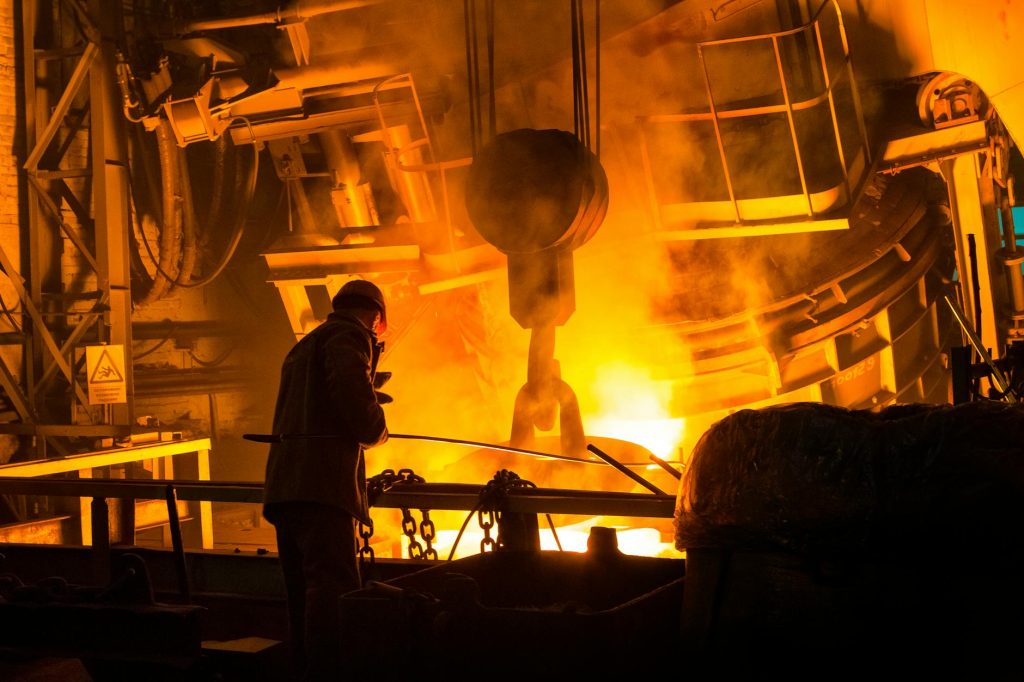
The challenge is vivid at POSCO, South Korea’s largest steelmaker. Lee Young-jin, 58, is one of 29 “master craftsmen” the company selected to pass on its expertise. His specialty is the converter process, in which oxygen is blown into molten iron to strip impurities and tune its properties. He judges temperatures of 1,600–1,700°C from flame color alone, weighing the metal’s hue, sound and the shape of the sparks to decide how much oxygen to inject and for how long.
“I relied on my five senses to read more than 70 subtle signs,” he said, describing the pitch of splattering iron and the faint heat of the workshop floor. Technique can be taught from a manual, he added, but the intuition to grasp the metal’s state takes years to accumulate. POSCO has spent the 2010s converting such judgment into data, using deep learning to mimic the know-how of workers with 30-plus years of experience. The result is “one-touch converter operation”: a worker presses a button and the optimal process runs, erasing the quality gaps that once varied by operator.
A core asset on the verge of being lost
South Korea is a manufacturing powerhouse — the sector’s share of GDP is the second-highest among OECD countries — and that strength has helped it weather U.S.-China trade tensions and supply-chain shocks. But the skilled workers underpinning it, many from the country’s “second baby-boom” generation (born 1964–1974), are now retiring in large numbers. Big firms have long studied how to preserve such tacit knowledge — expertise that cannot be conveyed in words or manuals — but many small and mid-sized manufacturers cannot guarantee continuity once a key worker leaves.
The government program targets nine fields, including autos, shipbuilding, steel, machinery, electronics (chips and displays), bio-chemicals, defense, foundry trades and textiles. Evaluators at the Korea Institute for Advancement of Technology say the hard part is capturing “unstructured” multimodal data — motion, sound, vibration and judgment — as time-series records. One official cited a shipyard example: on rainy days, humidity rises, air bubbles form and welds turn faulty, so seasoned welders quietly add more material. The aim is to teach an AI that context, then test whether less-experienced workers, guided by the model, can match a master’s output.
Who owns this labor?
Labor groups back the goal but warn about the method. The Federation of Korean Trade Unions, at a May 12 government roundtable, said it shares the push to use AI for industrial renewal but objected to advancing it without social dialogue on job losses. It flagged risks that companies could monopolize the profits, that personal privacy could be exposed during data extraction, and that AI-optimized models could become the yardstick for reassigning or dismissing staff. Some solution developers and master craftsmen also questioned how much of a lifetime’s know-how can or should be handed over, and noted that company-employed masters may avoid participating over trade-secret concerns. Regulators say the data is meant to be managed at a national level rather than hoarded by any single firm, with usage decided in consultation with the providers.