Why it matters. Beyond the scenery, the trail is a window into one of South Korea's defining domestic challenges: the slow emptying of its rural mountain villages as the population ages and young people leave.
Background. Mudeungsan is a national park overlooking Gwangju, the largest city in the southwestern Jeolla (Honam) region, long known for its strong tradition of civic resistance — from the 'righteous army' militias of past invasions to the 1980 Gwangju Uprising. The 'righteous army' (uibyeong) refers to volunteer fighters who repeatedly mobilized during national crises, and the Byeongja War of 1636–37 was the Qing invasion that forced Korea's king to surrender. The Mudol-gil is a modern recreational trail rebuilt over genuine historic footpaths that villagers once used to cross between towns.
What to watch next. Expect continued government-led ecological restoration of former farmland into wetlands, even as the surviving highland hamlets keep shrinking toward eventual depopulation.
On June 6, a hiker set out along the Mudol-gil, a network of restored old footpaths circling Mudeungsan (Mt. Mudeung) on the border of Hwasun County and the city of Gwangju in South Korea’s Jeolla region. The day’s walk traced roughly 12 kilometers of ridgeline trail, weaving together quiet mountain scenery, centuries-old history, and the fading life of remote highland villages once nicknamed “Korea’s Alps.”
A Pavilion, a Lake, and a 17th-Century War
The route began at Hwansanjeong, a small wooden pavilion perched at the edge of Seoseong Reservoir in Hwasun. Reflected in the still water against the sheer cliffs of Seoam, the pavilion seems to float like an island. The spot is tied to Ryu Ham, a Confucian scholar who raised a volunteer militia during the Byeongja War of 1636–37, when invading Qing forces from China besieged Korea’s king at the Namhansanseong fortress.
Ryu Ham is remembered for a fiery call to arms in which he urged the people of the Honam region — today’s Jeolla — to rise and defend the crown. For Korean readers, his story is shorthand for the uibyeong, or “righteous army” tradition: ordinary scholars and farmers who took up arms in national emergencies. The Honam area is especially proud of this heritage, and the pavilion frames it against a postcard landscape.
Crossing the Pass to “Korea’s Alps”
From there the trail climbed to Keunjae, the high pass that hikers consider the highlight of the eleventh Mudol-gil section. For generations, villagers crossed these passes for survival — carrying goods, supporting families, seeking a better life. Keunjae linked the deep mountain hamlets to the towns of Hwasun and Gwangju, a vital artery even when winter snow made it nearly impassable.
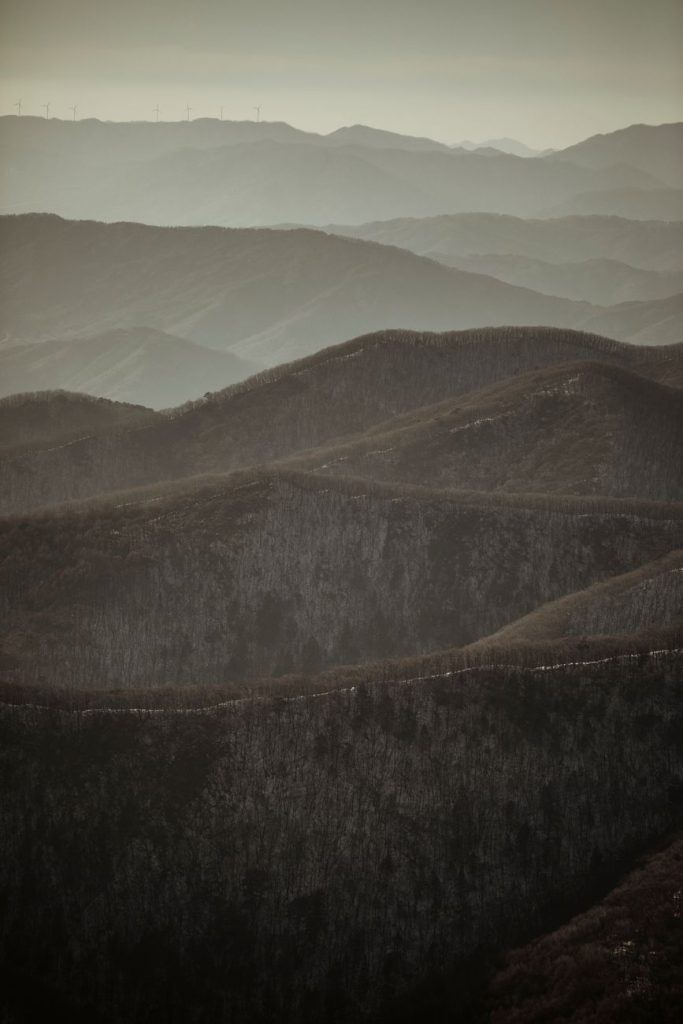
From the crest, the Sumalli villages spread out below, ringed by green ridges, deep valleys, and drifting white clouds — the view that earned the area its “Korea’s Alps” nickname. Just beneath the pass lies Sumalli Ecological Park, a restful patch of wetlands, cypress groves, maple stands, and barefoot walking paths laid out along wooden decks.
Eighteen Households and an 89-Year-Old Elder
The path then runs through Deulgukhwa (“Wild Chrysanthemum”) Village toward Jungji Village, the highest of Sumalli’s four natural hamlets at 409 meters above sea level. There the hiker met a resident shouldering a pesticide tank, who had returned to his hometown after a career in public service.
“Eighteen households live here now,” the man said. “Not a single outsider, and the oldest resident is 89. The hillsides around the village used to be full of terraced rice paddies.”
The encounter captures a quiet crisis facing rural Korea: aging, shrinking villages with no young newcomers. Some of those old terraced paddies are now being returned to nature. Since 2022, the Korea National Park Service has bought up land and rebuilt wetlands here — reversing damage from past goat grazing and pasture clearing, and replanting native species to revive the ecosystem.
The Walk’s Lingering Echo
From Jungji, the trail descended gently through broadleaf forest, dappled with early-summer light, before reaching the pavilion at Yongyeon Village. Beginning at Hwansanjeong and ending at Yongyeon by way of Keunjae, the ecological park, and Jungji, the day’s journey braided together nature, history, and the lives of mountain people — a route whose stillness lingers long after the walking stops.